Wednesday, April 6, 2011

Projectile motion


CASE 1


CASE 2

Personally, I could only find 2 cases within the package of work. That'll have to do.

Monday, March 28, 2011

Aerodynamics

To put it simply put, aerodynamics is how things move in air. There are 4 main forces that act upon objects when it comes to aerodynamics.


WEIGHT - Everything on Earth has weight due to the force of gravity. To remain airborne, an aircraft needs something to push it in the opposite direction from gravity.


LIFT - This is the force that counteracts the force of gravity. To fly, the lift must be greater that that of the weight. An example would be an airplane in which its wings generates the lift it needs to fly. The amount of lift created greatly depends on the shape.


A yellow, elongated teardrop shape is surrounded by blue dashed lines
The shape of the airfoil allows for greater lift.
DRAG - Drag is a force that tries to slow something down. It makes an object harder to move due to the force pushing it back. The shape of an object also changes the amount of drag. The more air that hits a surface, the more drag it makes. 

THRUST - Thrust is the force that counteract the force of drag. Thrust is the push that moves something forward. For an aircraft to keep moving forward, it must have more thrust than drag.

A drawing of an aircraft surrounded by four yellow arrows and the words Lift, Thrust, Weight and Drag
When you add them together.

Saturday, March 26, 2011

Physic Homework


Our Physics Homework:
Hard, but with enough practice, manageable

Wednesday, March 16, 2011

Kinematics Graph Translation

Credits to Cindy's group

Position vs. Time

Position vs. Time
Velocity vs. Time

Velocity vs. Time


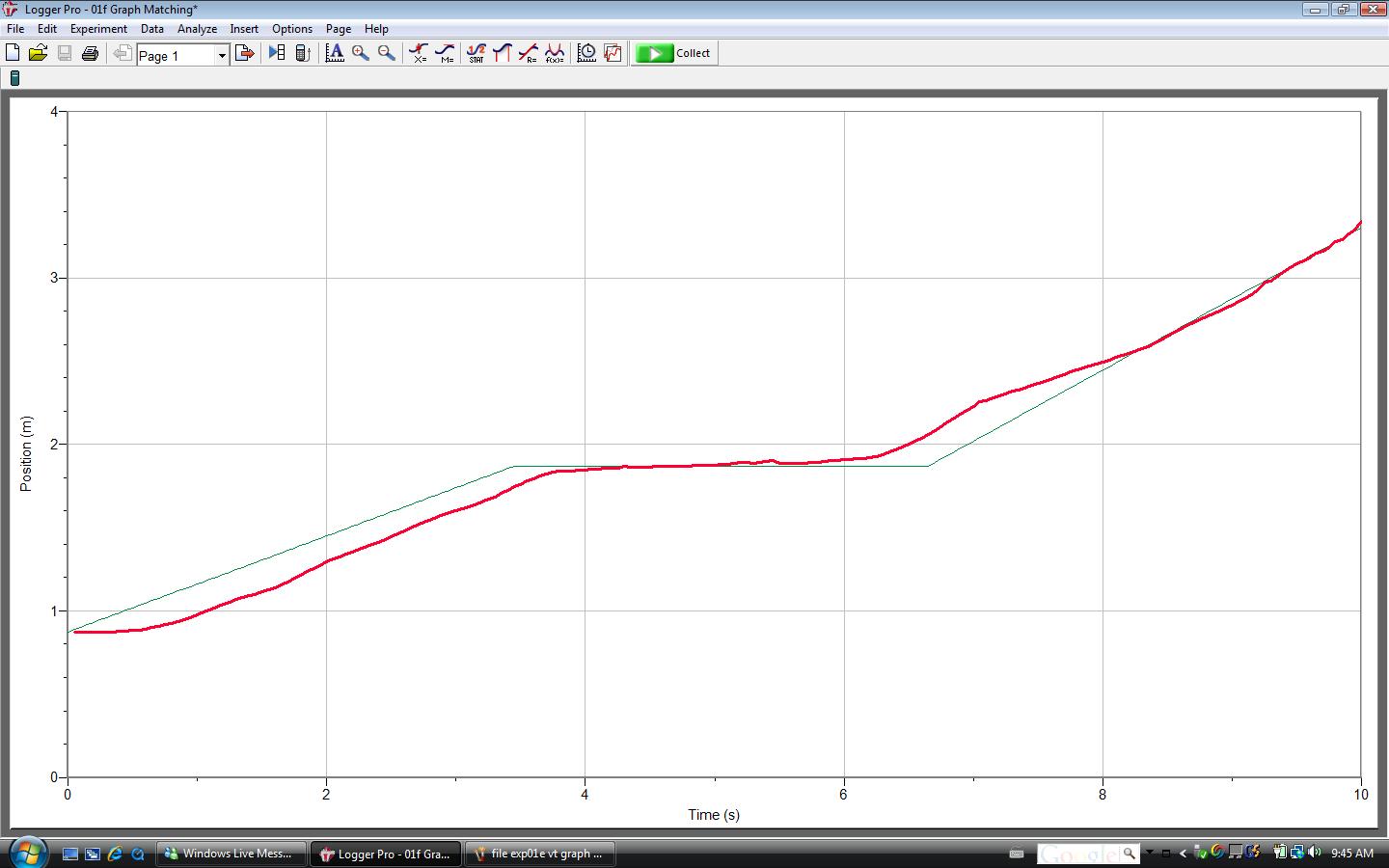
 These graphs are the results of the "Walking the Graph Lab", displaying either Distance vs. Time or Velocity vs. Time.

DT is the more manageable of the two. The further back you go from the origin the higher the graph line goes, and the closer you get to the origin the lower the graph lines go. If the line becomes horizontal the you are standing still. It's important to note that the entirety of these DT graphs had us moving at a constant pace. Simple. 


VT is a little more challenging. A sloping line away from the x-axis meant that you were steadily increasing your speed away from the origin. However, a sloping line away from the x-axis in the NEGATIVE quadrant meant that you were steadily increasing speed towards the origin. Opposite directing lines mean that you were decreasing speed, and a horizontal line meant a constant velocity was kept.

Overall thats not too hard.

Walking the Graph

"Slower!"
"Faster!"
"You have to go farther back, it goes from here to here."
"Come closer!"
"STOP!"

These are not sexual innuendos--no matter how likely it seems that they are--, but are the things yelled across the classroom during our Walking the Graph lab. The purpose was to teach us how to accurately match a graph displaying Distance vs. Time and Velocity vs. Time by our physical walking patterns tracked by a motion detector. The data was then inputed into the computer and compared side-by-side with the target graph. Although the DT graphs were fairly easy to match, the VT graphs seemed downright impossible. Perseverance came through, however, and we managed producing adequately shaped graph lines.
Set it up and off you go. 

That's pretty good for a blind person

Oh wait a sec.

Tuesday, March 1, 2011

Right Hand Rules 1 and 2

The right hand can be used for infinite amount of tasks --yes including that, but I didn`t say it-- and one of those tasks include finding the magnetic field. I would like to stress that everything from here on is under conventional current flow i.e. from the positive terminal to the negative.

RIGHT HAND RULE 1

The first right hand rule allows you to find the direction of the concentric circles (magnetic field) in a straight conductor by using, well, your right hand. Your thumb will point to the direction of the current flow, while the curve of your hand indicates the direction of the magnetic field circles.


RIGHT HAND RULE 2

The second right hand rule allows you to find the north side of the magnet in a coil. That`s right, were "AMPING" it up --aha, oh snap. Anyway, by curling your hand to the direction of current flow and sticking your thumb out you will point to the north pole of the magnet. Yep, its as simple as that.
If she can do it, you can too.
There is "technically" a third right hand rule, but we ain`t gonna bother ourselves with that today.
That is all.


Concept Map + 10 Things You Need To Know About Electricity


1. Current is the flow of charge ( I ), and is measure in Amperes. The equation for current is I = Q/t

2. Conventional current is the flow of current from the positive terminal to the negative terminal, as opposed to electron flow, which is from negative to positive.
3. DC/direct current (single direction flow) vs. AC/alternating current (vibrational movement of charge)
4. Series vs. Parallel circuits
5. Ohm's Law
6. Kirchoff's Law
7. Resistance is anything that impedes current flow, and is measured in Ohms. The equation for resistance is

 R = V/I
8. Voltage is the potential difference between two points ( V ), and is measured in volts. The equation for voltage is 

V= E/Q
9. Power is the rate at which work is done (P), and is measured in watts. The equation for power is P = IV
10. How to draw complex circuits with voltmeters and ammeters

Saturday, February 12, 2011

Introducing Ohm and Kirchhoff

I got two laws for you today, Ohm's Law and Kirchhoff's Law. These two laws have become intertwined with each other to help mankind complete circuit questions throughout time--yes it is that Earth shattering. 
It's also useful for baking cookies.
Essentially, Ohm's law demonstrates how to find the resistor, current, or charge if you have the other two variables. Kirchhoff--being the little genius he is--discovered something a little different. Are you ready for it?
BAM
Wait that wasn't its. Okay here it is:
SERIES CIRCUITS
It = I1 = I2 = I3 = In
Vt = V1 + V2 + V3 + Vn
Rt = R1 + R2 +R3 + Rn

PARALLEL CIRCUITS
It = I1+ I2 + I3 + In
Vt = V1 = V2 = V3 = Vn
1/R = 1/R1 + 1/R2 + 1/R3 + 1/Rn

Thats right, HE FORMULATED SIX FORMULAS.
Although this is not a race, if it were Kirchhoff would be totally winning. Together, our class discovered that they could be used to solve a bunch of varying circuit questions. Of course they are hard, but the fun is in solving these like sodoku-esque puzzles. Okay now go do some, have fun.

Wednesday, February 9, 2011

My Favorite Roller Coaster Design

Loops, helix, steep drop, ridiculously long lineup. These words are sentiments to roller coasters, a well-known attraction across the world. My personal favorite roller coaster HAS to be based of a coaster that i had gathered up the testosterone for, which is why I have chosen Six Flags Great Adventure's Nitro. I'll put it out there that I am not a coaster fanatic, so don't blame me for my lack of choice. I would also like to state that, "yes" Kingda Ka is at that Six Flags, and that "yes" I essentially did not have the balls to ride that thing.
 
That's right I have relatively high testosterone levels.

One of the designs that make this coaster so insanely awesome is its vertical drop down to "DOOM"--disclaimer: I may or may not be exaggerating. However, the most ridiculous part of this coaster are the highly banked horizontal loops. Those things will stick yourself to yourself.
Finally I would like to point out that Nitro had won third place in Golden Tickets' best steel coasters, so suck that anyone who says Behemoth!

-P.S I'm tall

From Batteries to Circuits

Batteries come in all shapes and sizes--small, big, energized bunnies--,but they all serve the same purpose when placed in a circuit. Its two ends, negative and positive, both must be connected to charge electrons to create a current, powering things like your toaster or microwave.
Or both.

Inside the battery a chemical reaction occurs allowing the electrons to "charge up" and essentially move through the circuit towards the positive end. If a load is placed along the circuit, the charged energy will be released, most commonly as heat or light.
Energy + Rabbits = Energized rabbits.
This process is known a energy transformation as the energy withing the battery is changed over the course of the circuit. Guess that's interesting.

Monday, February 7, 2011

Energy Balls

I'll be honest when I say i wasn't present for the experiment done on Friday, and that everything from here on will be an educated assumption on what had occurred that day. So, let's get started shall we.

Based on a "series"--Aha, get it "series"--of blogs that I have read thus far, the class was in for a treat that Friday morning. There was electricity in the air--Oh snapples, there i go again--as the class was given mysterious ping pong balls with two metal points codenamed "Energy balls". When in contact with these metal points the ball would light up and buzz. Was this some sort of magic, or was it PHYSICS.

As it turned out by using their bodies, the students were able to create a series circuit, which entails a single path on which the current flows.
 

Although we can't totally out rule magic.


The whole class was then subsequently asked to link pinkies together in an attempt to create a parallel circuit. This allowed multiple pathways toward the loads--a device that turns electrical energy into another form of energy i.e light bulb--assuring the lights would continue to glow despite being an incomplete circuit.

Like this but with flesh human bodies
In conclusion, this was a fantastic way to start the class. I would now like to end with another play-on-word:
"Don't play with electricity or you will get grounded'"